Correcting the Record on The Spectator and Tory Party “Truther” Defamations
On 13 November 2026, campaigner Heidi Bachram posted a clip on X from a talk I gave at a meeting in Parliament in March 2010. Her posts presented me as a 9/11 conspiracist, unfit to lead investigations at Byline Times. Three days earlier, The Spectator published an article by Andrew Gilligan stating that I “had a record as a 7/7 truther”. Both are now circulating on social media. On 15 November, two days after Bachram’s posts, the Shadow Justice Secretary, Nick Timothy MP, repeated her charge, writing on X that Byline Times “employs a 9/11 truther”. He offered no evidence. On 16 November, The Spectator published a second article by Gilligan, about Byline Times and the Bylines Network, which calls me “BT’s truther king”.
My published work makes the opposite case. Since my first book, The War on Freedom, in 2002, I have argued that al-Qaeda was responsible for the 9/11 attacks, and that Western governments’ relationships with its state sponsors, Saudi Arabia and Pakistan in particular, compromised Western intelligence work and let the attackers operate with impunity. My work on the 7/7 bombings asks similar questions of Britain: what MI5 knew beforehand about the four bombers, who operated as part of an al-Qaeda network; to what extent Britain’s relationships with Islamist groups compromised intelligence work; and why the Government refused an independent inquiry.
Bachram’s and Gilligan’s claims, which appear to have emboldend Nick Timothy, both rest on omission and what appears to be deliberate distortion. Bachram’s posts report half of a two-sided point I made about proof, and leave out my description, in the same talk, of the men at the centre of the 9/11 plot as Salafists close to bin Laden. Gilligan fails to mention that I have publicly condemned 7/7 conspiracy theories, including to the face of a former MI5 officer promoting them.
In neither case was I offered a right of reply. If I had been, I would have pointed to what I wrote over a decade ago on these pages. Instead, the opportunity to give my actual words and perspective was denied:
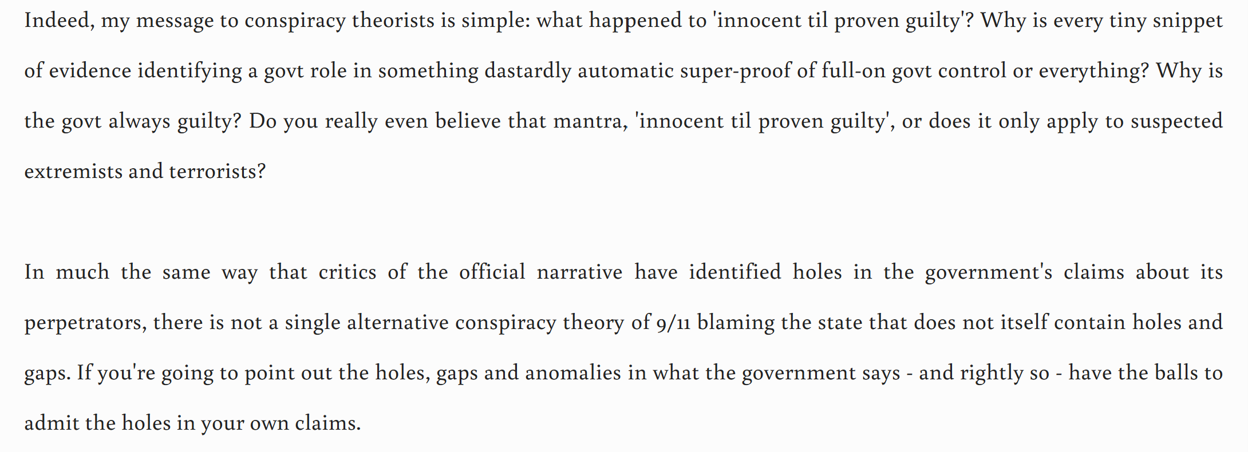
Source: Screenshot from an essay written over a decade ago!
What I Argue About 9/11
My position on 9/11 is on the public record, in my own words, and has been consistent for more than two decades. Here are three statements, from 2005, 2010 and 2015.
Capitol Hill, July 2005. On 22 July 2005, a year after the 9/11 Commission published its report, I gave evidence at a Congressional briefing on Capitol Hill convened by Cynthia McKinney, then a member of Congress. My evidence concerned bin Laden’s state backers. I cited a classified US intelligence report recording that in April 1991 Saudi Arabia’s intelligence chief, Prince Turki al-Faisal, struck a secret deal with Osama bin Laden: he could leave the kingdom with his money and supporters, on condition that he did not attack it. I cited respected American journalist Gerald Posner’s reporting that US intelligence knew of the arrangement. Then I asked:
If we are allying ourselves in some manner with al Qaeda in this rather direct way, how can we fight a war and win?
McKinney entered my remarks into the Congressional Record on 26 October 2005.
It is clear from this testimony that I argued that al-Qaeda is the enemy which perpetrated the 9/11 terrorist attacks. The question I put to Congress was why Saudi Arabia appears to have sponsored al-Qaeda with the knowledge of US intelligence, and what potential dangerous consequences could this strategy have had?
The Independent on Sunday, February 2010. A month before the Parliament talk that Bachram clipped, I had set out my actual thesis on 9/11 in The Independent on Sunday, replying to an attack on me by Christopher Hitchens:
“… the pre-9/11 intelligence failure was not simply because of a lack of reliable intelligence, or because intelligence bureaucracy was hopelessly incompetent (which it was and is), but ultimately because the Bush administration made political decisions that obstructed critical intelligence investigations and ongoing information-sharing that could have prevented 9/11. Those decisions were made to protect vested interests linked to US support of Islamist extremist networks like the Taliban and their state-sponsors, such as the Gulf kingdoms, rooted in Western oil dependency and intersecting financial investments.”
In my book The War on Freedom, I had argued that the conduct of senior US officials during the attacks, among them General Richard Myers, Dick Cheney and George W Bush, amounted to “a systemic dereliction of duty”. I wrote as follows:
I have used the term ‘complicity’ to characterize this dismal failure in the strict sense of criminal law – the US legal definition of complicity applies ‘when someone is legally accountable, or liable for a criminal offense, based upon the behavior of another’, and is implied specifically in the following sense: ‘… having a legal duty to prevent the commission of the offense, a person fails to make an effort he is legally required to make.’
Complicity in that sense is a charge of negligence against officials who had a duty to act and failed to. It did not accuse any officials or the US government of planning the attacks.
The Independent’s news report by reporter Kate Youde on the my dispute with Hitchens, published the same day, recorded my position: I had suggested a “dereliction of duty”, with no conspiracy, and I “used the word ‘complicity’ in a legal sense” (The Independent on Sunday, 7 February 2010).
My blog, August 2015. In an essay on my blog a decade ago, easy to find and check, I wrote: “My position on 9/11 is pretty simple: I don’t indulge in theory. I detest speculation.” I then listed what I argue can be proven as fact, including that:
… the US relationship with states like Saudi Arabia and Pakistan directly correlates with high-level blocks on intelligence investigations into terror networks (including al-Qaeda) subsidised by those regimes;
and that
… the 9/11 attacks likely received significant direct state-sponsorship in the form of logistical and financial support from key US allies (including Saudi Arabia and Pakistan), which US authorities have systematically attempted to conceal from public understanding …
Each of these statements starts from the same premise: al-Qaeda’s operatives carried out the attacks. The questions I ask in relation to this: who sponsored these operatives? Who shielded the sponsors? Why is it that the intelligence investigations that could have prevented the plot were blocked? The 9/11 families have now put the Saudi part of that issue to a federal court t in New York.
Investigative Impact of My 9/11 and 7/7 Reporting
The families and survivors of both attacks have used my work to press for answers. This has fed directly into official inquiries and legal action.
9/11. Relatives on the 9/11 Family Steering Committee, who had campaigned for the 9/11 Commission, used The War on Freedom to help set its lines of inquiry. The book is one of 99 titles in the US National Archives’ 9/11 Commission Materials collection, which holds a copy of each book made available to the 9/11 commissioners. In July 2005 I gave evidence alongside members of the Committee at the Congressional briefing described above.
From the start, my work examined Saudi Arabia’s role, and influenced how the 9/11 families pursued that question in those early years. The question is now at the heart of their civil case against Saudi Arabia: in August 2025 a federal judge in New York found the families had shown “reasonable evidence” that two Saudi citizens were sent by their government to the United States to assist the hijackers. I see this as vindication for my work - I was one of the first to systematically investigate the dubious Saudi state role in relation to the 9/11 hijackers.
7/7. Survivors of the London bombings, among them Rachel North, Holly Finch and Professor John Tulloch, backed my call for an independent public inquiry. My 2007 parliamentary briefing paper, Inside the Crevice, produced with the support of Garden Court Chambers, examined MI5’s surveillance of two of the bombers, Mohammad Sidique Khan and Shehzad Tanweer, during Operation Crevice in 2004. This report was used in the 7/7 Inquiry Group’s application for judicial review of the Government’s refusal to hold an inquiry (October 2007). Parliament’s Intelligence and Security Committee re-examined MI5’s knowledge of the bombers in 2009 (ISC), and the inquests examined it again in 2011, where Inside the Crevice was required reading for legal counsel.
In print. Reviewing my second book on 9/11, which was far denser and more expansive than my first - The War on Truth (2005) - in The Independent, commentator Yasmin Alibhai-Brown called it a “disturbing and clearly evidenced book”. The Sunday Times called The London Bombings: An Independent Inquiry (2006) “lucid and persuasive”, and Library Journal called it “a devastating critique” of the Government’s official report.
Heidi Bachram’s Claims
Bachram’s two posts make four claims.
The Bin Laden Point
Bachram wrote that I was “claiming that the government hasn’t ‘proved its case’ on Osama bin Laden and 911”. The line comes from my closing remarks, where I urged the audience to stop arguing over theories and focus on the documented record:
… this divide is an artificial one … you have conspiracy theorists and then you have people who are against conspiracy theories … we need to come out of this constructed divide and focus … fundamentally on what we know, and ask really hard questions about those issues.
Because it’s clear that we cannot establish a paper trail on either side. … it’s clear that the government hasn’t really proved this case about the hijackers, for example; they ha[ven’t] proved their case about Osama bin Laden. … There’s no paper trail which says that this particular individual gave an order on this [date], allowed the planes. Well, we have no way of establishing that.
… we’re much stronger if we focus less on those particular interpretations and focus on the contradictions [and] anomalies.
Bachram’s post cherry-picked one line and left out everything around it: that no one had shown that any official ordered or allowed the attacks, and my call to drop the theories and focus on documented anomalies. By excluding the context, she attempts to show that I am hinting at an alternative conspiracy theory.
My point was about proof. This is all pretty well known to researchers and experts familiar with 9/11. The UK Government’s own dossier of 4 October 2001 said, for instance, it did “not purport to provide a prosecutable case against Usama Bin Laden in a court of law”. The alleged 9/11 mastermind, Khalid Sheikh Mohammed, and three co-defendants, accused of planning the attacks, have still not been tried; a military judge has set their trial for June 2028. Although bin Laden claimed responsibility in a video in October 2004, 25 years on no court has actually tested the case against him. And as I pointed out at length in the 2010 talk in parliament, the 9/11 Commission report was based significantly on accounts provided by tortured detainees, leading its own chairs and consultant to question the reliability of its claims.
I raised the paper trail to highlight serious failures in the investigation, not to suggest that Osama bin Laden did not order the attacks, which I’ve never claimed. To use my words in this talk out of context to imply that I deny the role of bin Laden or al-Qaeda in 9/11 is the most ridiculous and egregious distortion one could imagine, contradicting literally hundreds of thousands of words I’ve written and published.
The failures in the official investigations, as I have argued throughout my work, stem from Western states’ long-standing relationships with Islamist groups and the regimes that sponsor them, Saudi Arabia and Pakistan above all (but also others such as Turkey and Azerbaijan).
This reporting has had serious repercussions for me personally. After my reporting on Turkey exposing its state sponsorship of ISIS was censored flagged and censored by courts there, I am unable to travel to that country.
My work puts Islamist groups and the regimes that sponsor them at the centre of the attacks, and so did the talk. Earlier in the very same talk, I described the men at the centre of the plot as:
“… very, very close to Osama bin Laden, part of this very strict Salafist Wahhabi puritanical trend …”
Bachram’s posts leave that description out. With it removed, a talk that placed Islamist militants at the heart of bin Laden’s 9/11 operation , but raised questions about their real character and motives, is presented as a denial of their role.
A Sourced Critique of the 9/11 Commission
Bachram wrote that Cynthia McKinney and I were “spinning all sorts of tales about 911”.
In reality, as noted, much of my talk was a critique of the 9/11 Commission, built from named sources: Lorie Van Auken, a 9/11 widow and co-chair of the 9/11 Family Steering Committee; FBI Special Agent Coleen Rowley, whose memo on headquarters’ obstruction of the Minneapolis office’s investigation of Zacarias Moussaoui was published in Time; and Philip Shenon’s history, The Commission (2008).
One of my key points was that the 9/11 Commission relied heavily on CIA interrogations of detainees subjected to harsh techniques. Its own consultant, the Harvard historian Ernest May, wrote in The New Republic that it never had full confidence in those accounts as historical sources. Its chair and vice-chair, Thomas Kean and Lee Hamilton, wrote in The New York Times in January 2008 that the CIA and the White House had refused the Commissioners access to the detainees and to their interrogators to attempt to verify the accounts themselves.
Apparently, pointing out these serious gaps is “trutherism” for the likes of Gilligan and Bachram. In that case, the 9/11 Commission’s own consultants and chairs themselves, along with the 9/11 families and an FBI whistleblower, are also “truthers” for asking these questions and pointing out these issues.
Las Vegas
Bachram wrote: “Ahmed cast doubt on the hijackers being Islamists because a few went to Las Vegas.”
In the passage she refers to, I discussed US investigators’ findings that five of the hijackers, including Mohamed Atta, visited Las Vegas at least six times between May and August 2001, as well as press reports that they drank, gambled and visited strip clubs there.
In the same talk, I described the men at the centre of the plot as Salafists close to bin Laden, asking what that conduct meant and why the 9/11 Commission had not investigated it. I noted these facts alongside the account of the former CIA officer Robert Baer, who said he had passed warnings about Khalid Sheikh Mohammed to the CIA’s Counterterrorist Center in 1997 and found “absolutely no interest”.
The Commission’s final report also said it had “seen no credible evidence explaining why” the operatives flew to or met in Las Vegas.
The question I was raising was crucial not trivial at all: what were the hijackers’ motives and whom else they were working with, including potentially Saudi intelligence? The discrepancies in their behaviour are precisely the kind of anomalies investigators need to think about in assessing their motives, especially given that they were working for a strictly Salafist Islamist group. The Saudi question is now before the US courts in the 9/11 families’ case against Saudi Arabia. Bachram’s post misleadingly reduces this passage about intelligence failure to “a few went to Las Vegas”.
The 2010 Meeting and Cynthia McKinney
Bachram wrote that McKinney and I “were speaking in Parliament in 2011”, called McKinney a “notorious conspiracist”, and added: “Not sure how they got in.” The implication apparently being that I am a conspiracist like McKinney.
The meeting took place on 8 March 2010. It was a meeting in Parliament; as I recall, the room was booked by the late Michael Meacher, then a Labour MP and a former environment minister.
Recordings of the talk were later posted online by others, including a 9/11 truth website, entirely independently of me.
I came to know Cynthia McKinney in 2005, when, as a sitting Democratic member of Congress, she convened the Congressional briefing described above and invited me to give evidence. At that time McKinney was seen as a credible Democrat Congressional representative who early on had asked questions about the 9/11 intelligence failure.
Others giving evidence at the McKinney briefing included Lorie Van Auken, Mindy Kleinberg and Monica Gabrielle of the 9/11 Family Steering Committee, the former CIA analyst Melvin Goodman, the former NSA officer John Newman, and Jumana Musa of Amnesty International. The 2010 meeting was the last time I met or had any contact with her.
Unfortunately, since then at some point I am entirely unfamiliar with, she began to drift increasingly into bizarre conspiracy theories, which I have nothing to do with and roundly condemn without reservation.
The Spectator’s 7/7 Claim
Despite writing two articles making allegations about me and Byline Times in The Spectator, Andrew Gilligan offered me no right of reply – a basic requirement of journalistic practice.
In his first piece, he says that I “had a record as a 7/7 truther”. His second article calls me the Byline Times “truther king”.
In reality, my work names Mohammad Sidique Khan, Shehzad Tanweer, Hasib Hussain and Germaine Lindsay as the 7/7 bombers, operating as part of an al-Qaeda network.
I am on record repeatedly opposing 7/7 conspiracy theories in person and in print. Gilligan has omitted all of this.
At the House of Lords launch of my book The London Bombings: An Independent Inquiry (Duckworth, 2006), the former MI5 officer David Shayler stood up and claimed that 9/11 and 7/7 were inside jobs. I told him, in front of everyone present, that his remarks were “a disgraceful affront to the 9/11 and 7/7 families”.
In 2015, I wrote that my work “is not, and never has been, about conspiracy theories”, and called the phrase “inside job” “a vague, amorphous cop-out typical of the conspiracy industry in general”.
Gilligan quoted me from a YouTube video, giving no date, event or context, saying that the “prima facie case that the government had some kind of dubious relation to the attacks … is almost a foregone conclusion”.
But my meaning here is clear from the context of all my published writing, where the “dubious relation” is the British security establishment’s relationship with the extremist networks the bombers came from: a policy of accommodating those networks in the hope of keeping Britain safe. In The London Bombings, I explain that British intelligence operatives had a name for this dangerous policy – it was called the ‘covenant of security’.
Thanks to the campaigning of 7/7 survivors and families, which my work helped support, Parliament’s Intelligence and Security Committee and the inquests went on to ask what the security services knew about the bombers, and why they failed to act.
I welcome scrutiny of my work, and anyone is free to disagree with it. But this is not fair scrutiny - it is deliberate distortion and misrepresentation of my position by cherry-picking comments out-of-context during a lengthy talk 16 years ago, apparently to denigrate my credibility as an investigative journalist in order to defame both myself and Byline Times, where I am head of investigations. In short, the characterisation of me and my work as conspiracy theory or trutherism is unsubstantiated and contradicts my own repeatedly stated position over several decades. I reserve all my legal rights, including in relation to anyone who repeats them.